

Portage Overview
The Mastery Learning System
Our students are expected to master Bio-Med Science Academy’s core curriculum concepts. If this mastery is not achieved in the first attempt, a student will be given additional time and remediation if needed. Each student must master a course in order to progress to the next course.
The Learning Management System
BMSA tracks a student’s course mastery progress using web-based programs designed to serve as a hub for coursework and communications. The programs is accessible 24 hours a day.
- Otus is used for grades K-3
- Toddle is used for grades 4-12
Mastery Learning: Bio-Med Science Academy Mastery Progression
Mastery Learning
We believe mastery learning and the Mastery Learning Record (MLR) align better with our Mission and Vision of nurturing the whole learner. The MLR is designed to showcase your learner’s mindset of growth and resilience while also highlighting academic achievement. This approach captures that learning is not a one-size-fits-all process and values each student’s growth and development. Bio-Med aims to create an environment where every student can thrive, feel confident in their abilities, and be prepared for the challenges and opportunities ahead.
What is mastery learning?
Since our inception, mastery learning has been a pillar to documenting and tracking our learner’s academic growth. Mastery learning is an approach that focuses on students achieving a deep understanding of key concepts and skills rather than simply accumulating points or reiterating surface-level information. In a traditional grading system, a student’s performance is often summarized in a single letter grade, which may not fully capture their progress or areas for improvement. Mastery learning, on the other hand, is designed to provide a more detailed and accurate representation of what a student knows and can do, not necessarily how hard they worked.
- Growth-Oriented Feedback – Instead of receiving a grade that might feel fixed or final, students receive feedback highlighting their progress toward mastering each objective. This feedback is meant to guide students on what they’ve done well and where they can improve, fostering a growth mindset.
- Opportunities for Mastery – One key advantage of mastery learning is that it allows students to learn at their own pace. If a student doesn’t fully grasp a concept the first time, they are encouraged to revisit it until they achieve mastery. The emphasis is on the process of learning and mastering content and skills rather than just moving on because the class schedule demands it.
- Building Confidence – In a traditional grading system, the fear of failure can sometimes overshadow the learning process. Mastery learning shifts the focus from “How do I get an A?” to “How can I deeply understand this material?” This should help learners build confidence as they see their progress over time, reinforcing the belief that they can improve with effort and persistence.
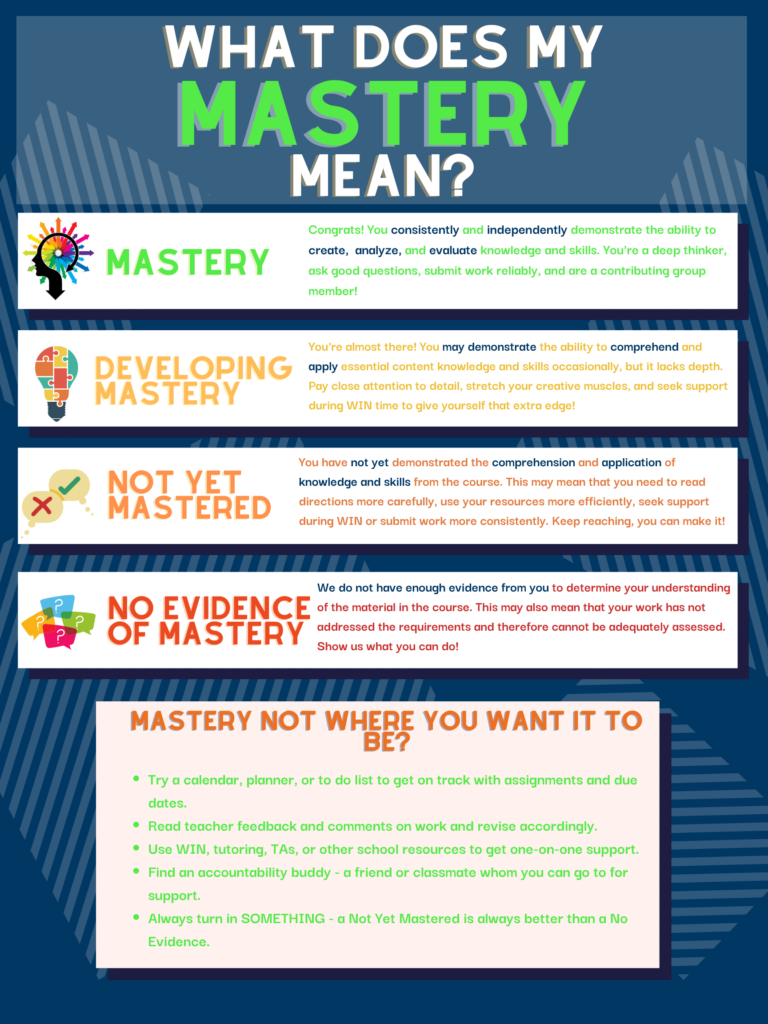
Students will not be considered to have mastered a course unless all evaluated areas are at or above Developing Mastery.